
Nostr Numbers in March 2026


Nostr is growing. The question is what kind of growth, and how much of it sticks. A public dashboard maintained by JeffG at stats.andotherstuff.org offers one of the clearest pictures available of network activity, drawing on data from Pensieve, an archive-first Nostr indexer that connects to dozens of public relays in real time. The numbers below are drawn from that dashboard as of 15 March 2026.
A note on methodology: Pensieve ingests and deduplicates events from public relays using ClickHouse as its analytics index. It does not capture events from private or paid relays, and events published before indexing began are excluded. These figures represent a comprehensive approximation, not a complete census.
Publishing users
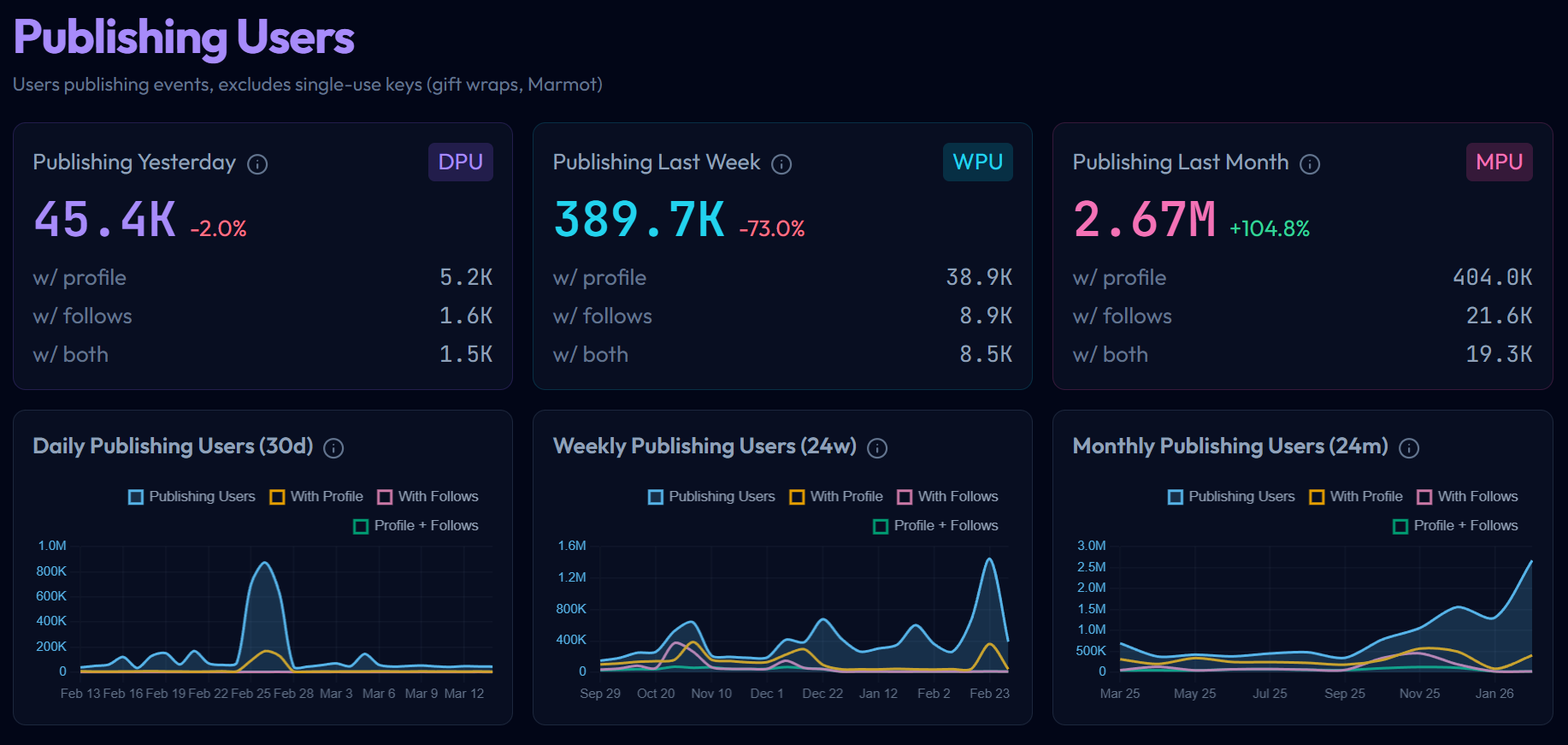
The dashboard tracks publishing users, defined as pubkeys that have published at least one event, excluding single-use keys such as gift wraps (Kind 1059) and Marmot encrypted group messages.
In the week ending 15 March, 389,700 unique pubkeys published events. Of those, around 38,900 had a profile set, 8,900 had a follow list, and 8,500 had both. The monthly count reached 2.67 million, up 104.8% from the prior month, with only 404,000 carrying a profile and 19,300 with both a profile and a follow list.
The gap between the monthly figure and the weekly number points to a pattern of large spikes followed by rapid falloff. The 24-month publishing users chart shows relatively flat activity through most of 2025, with a steep climb beginning around November 2025 and accelerating into early 2026.
New users
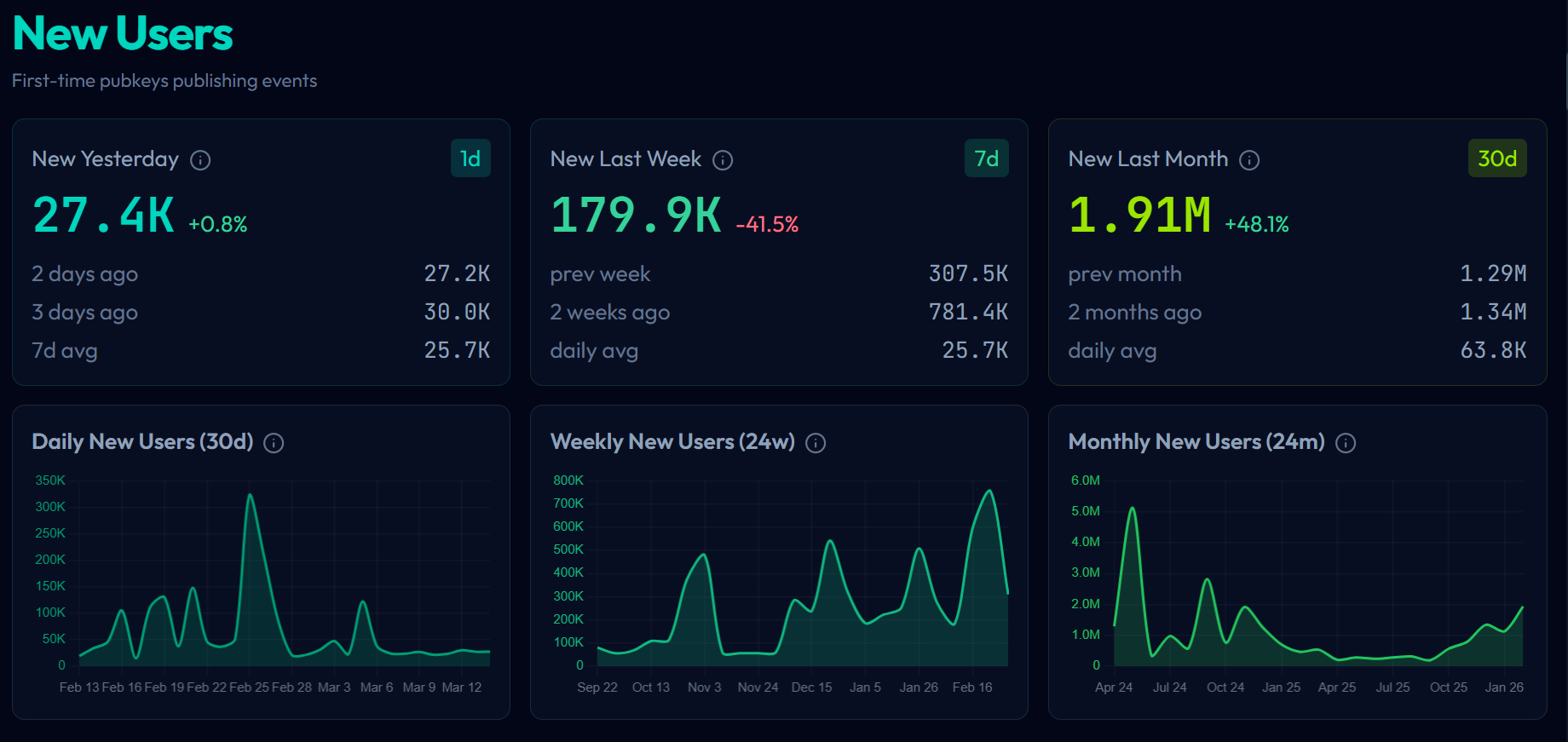
The new user numbers echo a similar pattern. In the most recent week, 179,900 first-time pubkeys appeared, down from 307,500 the week before and 781,400 two weeks prior. The monthly figure was 1.91 million, up 48.1% from 1.29 million the previous month.
The weekly new users chart over 24 weeks shows dramatic spikes, particularly in late January and February 2026, with peaks exceeding 700,000 new pubkeys in a single week. These spikes are followed by sharp declines, suggesting event-driven surges rather than steady organic growth.
User retention
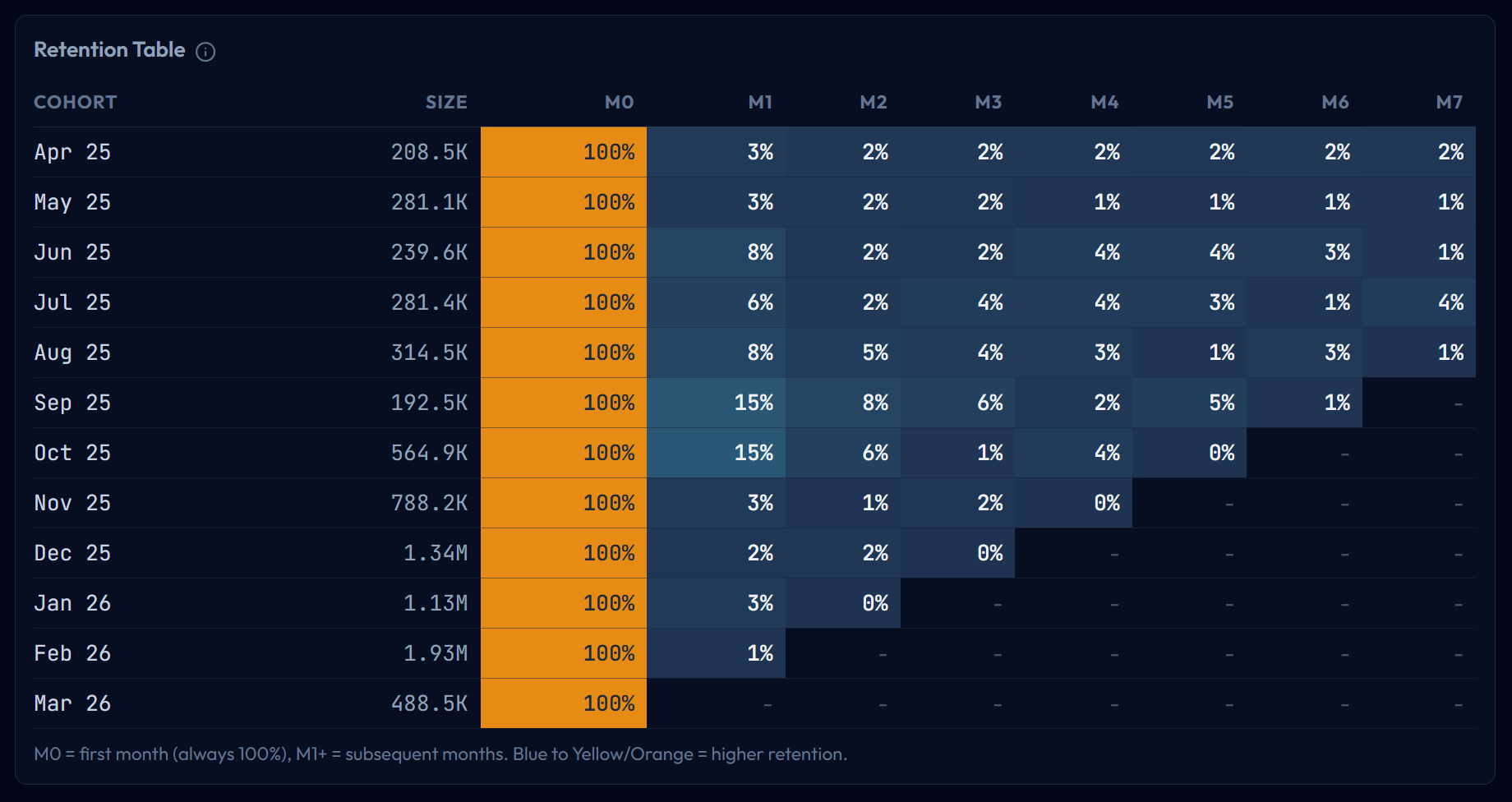
The retention data tells the most sobering part of the story. The dashboard's weekly cohort analysis tracks whether new pubkeys return in subsequent weeks.
Across cohorts from late December 2025 through early March 2026, first-week retention (W1) ranged from 0% to 6%. By week two, the figure typically dropped to 0-3%. By week three and beyond, retention was effectively 0% across nearly every cohort.
The December 22 cohort (541,700 users) showed 6% W1 retention, the highest in the visible data. The January 12 cohort (222,300 users) retained 4% at W1. Most other cohorts, including large ones like January 26 (508,400 users) and February 16 (587,700 users), showed 1-2% at W1 before falling to zero.
These figures indicate that the vast majority of new pubkeys that appear on the network do not return after their first week.
Zaps
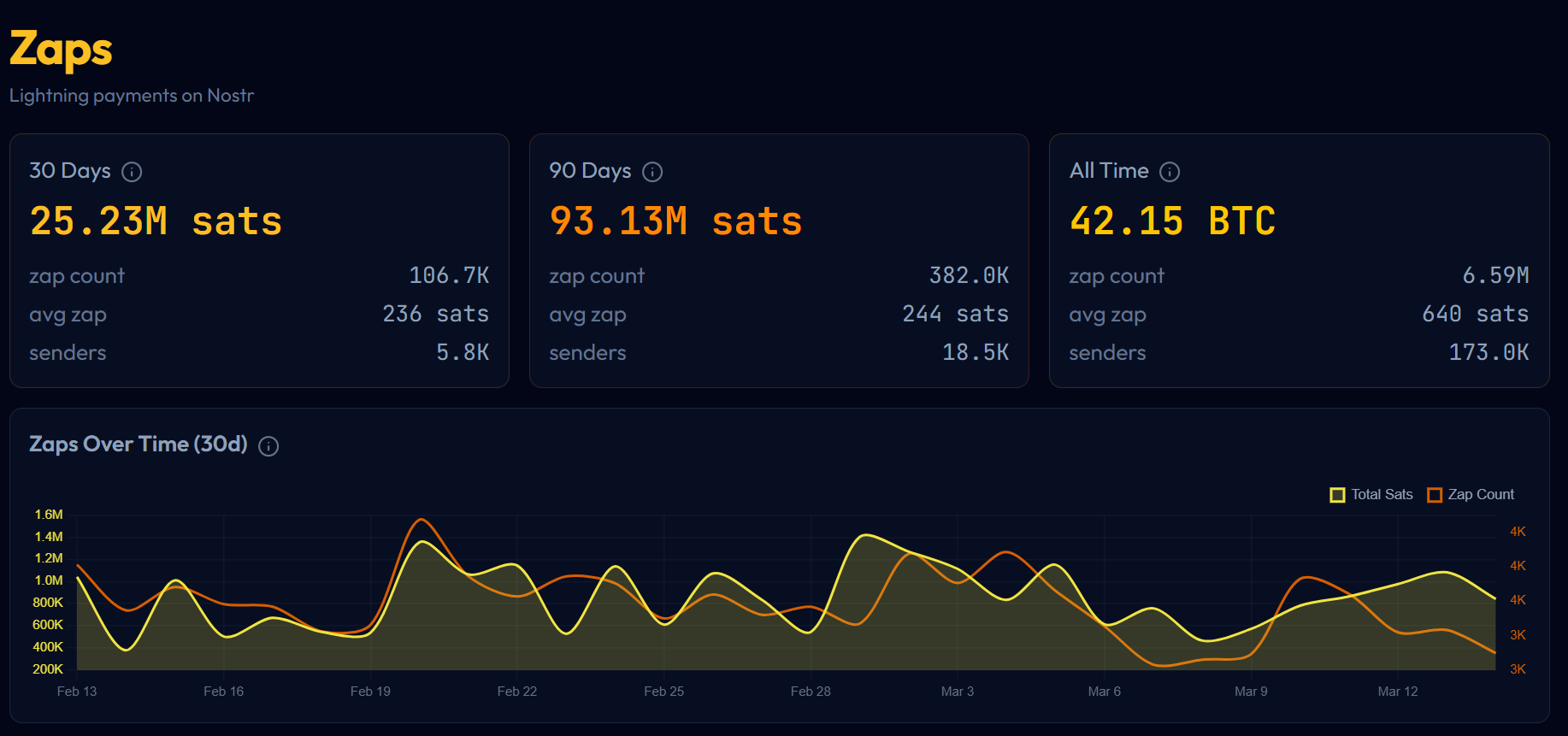
Lightning payments on Nostr, known as zaps (Kind 9735), show a small but active economy. Over the past 30 days, 25.24 million sats moved across 106,300 zaps from 5,800 unique senders, with an average zap size of 237 sats. Over 90 days, the total reached 93.07 million sats across 381,600 zaps from 18,500 senders.
All-time, the network has processed 6.59 million zaps totalling 42.15 BTC, sent by 172,900 unique senders. The all-time average zap size of 640 sats is notably higher than the recent 30-day average of 237 sats, suggesting either that larger zaps were more common in earlier periods or that a small number of large historical zaps skew the average upward.
Events
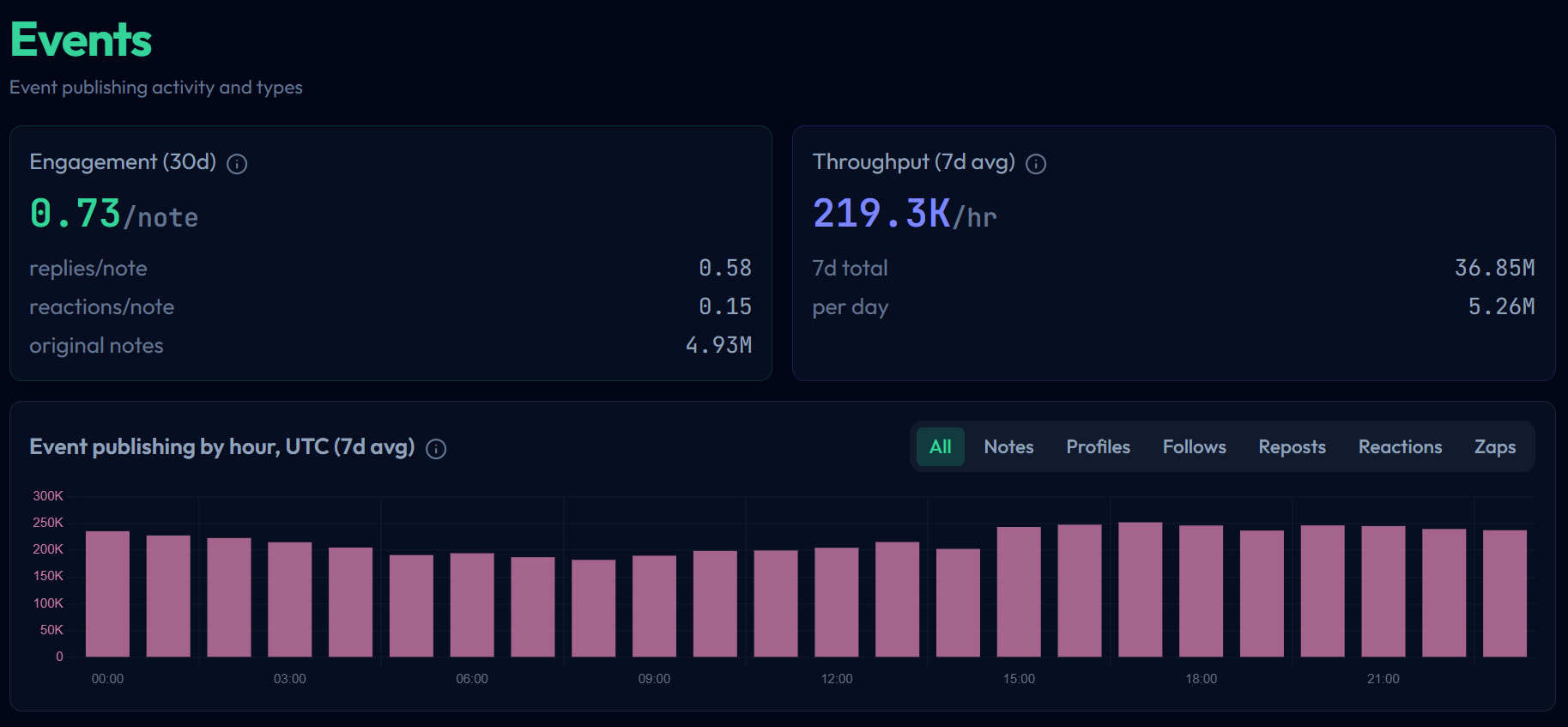
The network averaged 5.19 million events per day over the most recent seven-day window, totalling 36.33 million events in that week.
Engagement over the past 30 days averaged 0.73 interactions per note, broken down as 0.58 replies and 0.15 reactions per note, across 4.93 million original notes.
The hourly event publishing chart shows a clear daily pattern, with activity dipping between roughly 06:00 and 12:00 UTC and peaking between 14:00 and 22:00 UTC, consistent with a user base weighted toward the Americas.
Event types
The event type breakdown reveals where Nostr's volume lives.
Short Text Notes (Kind 1) lead with 205.18 million events from 38.52 million pubkeys. This is the core social posting activity, the equivalent of a tweet or a post.
Kind 20001, an ephemeral event type in the 20000-29999 range, accounts for 159.55 million events from 402,700 users. Ephemeral events are not expected to be stored by relays and are instead passed through to connected clients in real time. The high volume from a relatively small number of users suggests automated or machine-generated activity, such as relay coordination or client signalling.
Kind 30304 produced 82.06 million events from just 5 users, indicating a highly concentrated, likely automated use case.
Encrypted DMs (Kind 4) account for 76.02 million events from 2.46 million users. Reactions (Kind 7) total 65.74 million from 1.18 million users. User Metadata (Kind 0) has 37.90 million events from 14.58 million pubkeys. Reposts (Kind 6) total 36.46 million from 1.09 million users.
Gift Wrap events (Kind 1059), used for private messaging under NIP-59, show 13.62 million events from 13.61 million pubkeys, a near 1:1 ratio of events to users. This pattern is expected given that gift wraps use single-use keys by design.
Further down the list, DVM (Data Vending Machine) events appear across multiple kind numbers (Kind 22456, Kind 25050, Kind 38225), reflecting the emergence of a machine-to-machine services layer on the protocol. Nostr Connect events (Kind 24133) total 7.01 million from 24,300 users, indicating adoption of remote signing. Blossom Blob events (Kind 24242) for media storage total 6.79 million. Zap events (Kind 9735) total 6.64 million from 40,600 users. Channel Messages (Kind 42) for public group chat total 6.14 million from 285,000 users.
Relay distribution
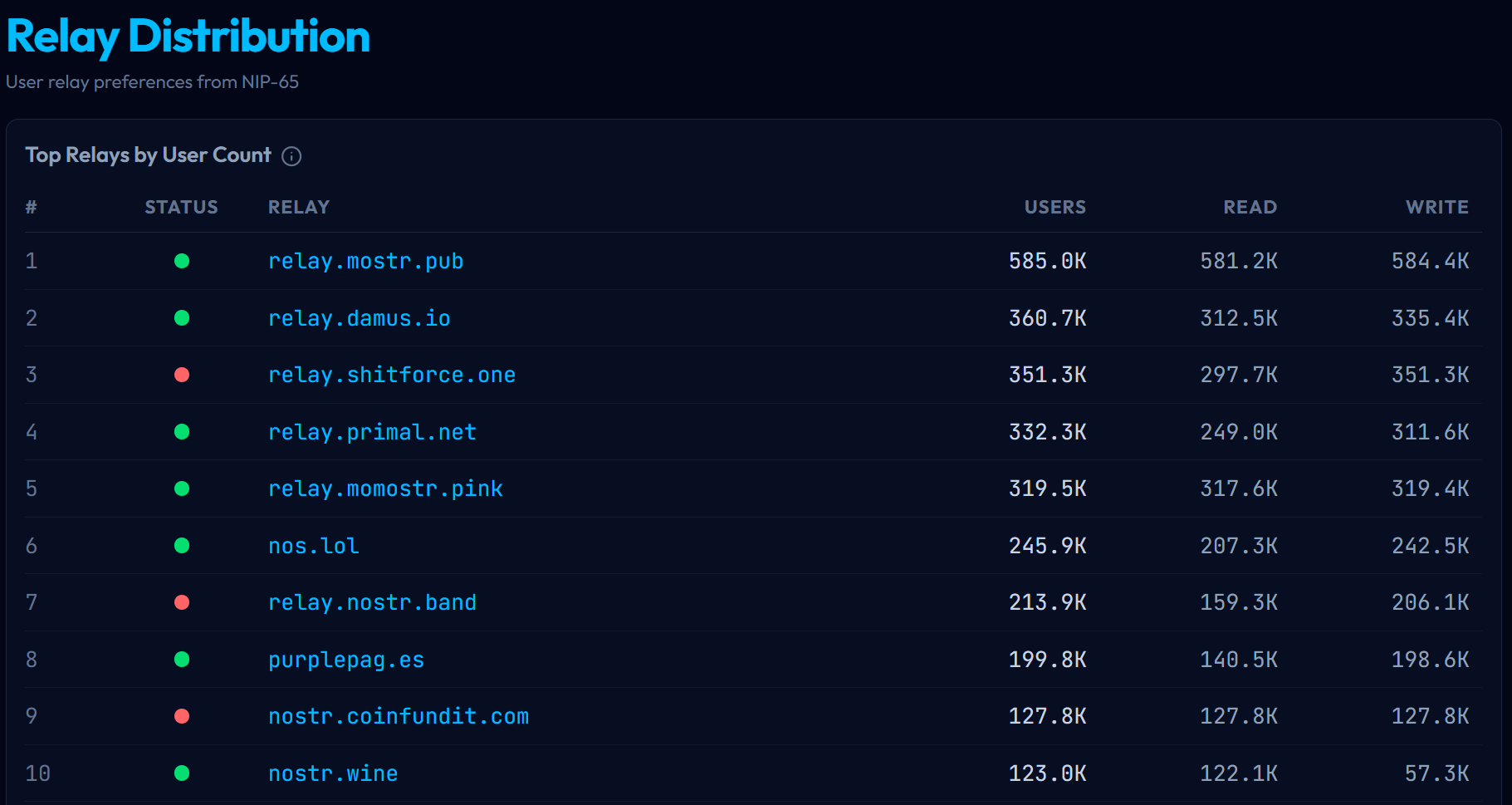
The relay distribution table, based on NIP-65 relay lists (Kind 10002), shows where users choose to read and write. The data refreshes every six hours.
relay.mostr.pub holds the top position with 585,000 users (581,200 read, 584,400 write). Mostr is a bridge between Nostr and the Fediverse (ActivityPub), built by Alex Gleason and Soapbox. Its dominance at the top of the relay table reflects the volume of Fediverse accounts bridged into the Nostr network. This also provides context for some of the new user and publishing user spikes: bridged Fediverse accounts registering pubkeys on Nostr count as new users in these statistics.
relay.damus.io sits second with 360,700 users, followed by relay.shitforce.one at 351,300, relay.primal.net at 332,300, and relay.momostr.pink at 319,500. nos.lol (245,900), relay.nostr.band (213,900), and purplepag.es (199,800) round out the top eight.
The geographic and organizational diversity of the relay list reflects a genuinely distributed infrastructure. Relays operated by application developers (Damus, Primal, Nos), community operators (nostr.wine, nostr.land, nostr.lol), and special-purpose relays (purplepag.es for profile data, relay.nostr.band for search indexing, relay.wavlake.com for audio content) all appear in the top 50.
What the data shows
As of March 2026 the Nostr network has significant event throughput, a functioning Lightning payments layer, a growing diversity of event types, and a distributed relay infrastructure. Monthly publishing users have more than doubled. New users are arriving in large surges.
The retention figures, however, show that almost none of those new users come back. The near-zero weekly retention across every cohort measured suggests that the headline growth numbers are driven primarily by key generation events rather than by users forming a habit of returning to the network. The Mostr bridge's position as the largest relay by user count also indicates that a meaningful share of measured activity originates from the Fediverse rather than from native Nostr users.
The data is drawn from Nostr Stats by JeffG, powered by the Pensieve indexer. Both are open-source projects from And Other Stuff.